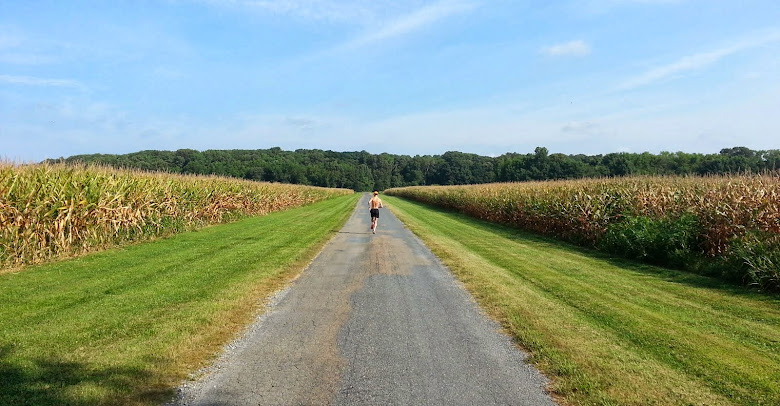
Wye Island NRMA

Wye Island NRMA

Monday, May 25, 2015

And Where Are You Going?: A Race Recap

We were moving fast on Light Street's gradual northbound descent to Pratt in the last mile of the McVet 5K.  There are uncommon moments in a race when things click.  Suddenly you feel strong, fluid, and confident, while covering ground quicker than anticipated.  This was our experience as Conrad and I postured in attempts to break away from the other.

Conrad and I beneath the Battle Monument, nearing the final stretch
This was my first road race since December 7.  Nearly four months of aches, injuries, and a body out of balance inhibited my training and dashed my ambitious plans for 2015.  In late March, I changed strategies and sought new motivations and challenges in trail running.  The soft surfaces helped my body heal while I regained fitness.   And spending more time exploring the region's forests revitalized my mind and spirit, reawakening dormant memories of my boyhood in rural Ohio.  But my road racing goals still simmered.  

I failed to update my blog regularly throughout this period of rehabilitation.  I logged daily on Strava and Running2Win, but I couldn't compel myself to do the hard work of reflective writing.  To recap, I began introducing fartlek, tempos, and threshold workouts - the vegetable protein (meat) and potatoes of my training regimen - in mid April, completing nearly all sessions on trails at Robert E. Lee Park and along the NCR trail.  Early workouts indicated that I had retained fitness during my quarter-year of fragmented training.  I tested myself at the Seneca Creek 10K, part of the Xterra Mid-Atlantic Series, where I finished first in 35:11 on a challenging trail.

May began with new adventures and additional indicators that my fitness was returning, attributable, I believe, to my embrace of the trails.  We spent the first weekend of May at a cabin in Rocky Gap State Park near Cumberland, a site warranting a blog post.  While there, I engaged tough, rocky climbs on Evitt's Mountain and completed my first 18-mile long run of the cycle along the Great Allegheny Passage Trail.  In the weeks since, my threshold and tempo workouts began resembling the splits I logged last fall.

I toed the line at McVet confident of my rebounding fitness but uncertain how fast I could run.  I also feared the aches and pains would return as I pounded pavement in featherweight flats.  Anxiety dissipated as the starter sent us off at a conservative pace over the gently rolling first mile, which we covered in 5:06.  Shortly after, I took the lead and gradually increased the pace, hitting mile 2 in 10:05 with Conrad on my heels.  Could we finish in the 15:20s?  Faster?

Conrad and I pressed hard after two miles of cautious pacing.  I fought tenaciously to hold him off, wary of my odds in a head-to-head sprint to the finish.  The last half mile climbed north on Calvert Street.  It was near the hill's peak that Conrad broke free and opened a small gap.  I continued digging, but he had momentum and I harbored self-doubt.  The day belonged to him.

We thrashed each other for 3.1 miles, testing each other's toughness and fitness on an honest course that included climbing and sharp turns.  Our rewards were watches that stopped at 15:09.6 and 15:12.6, near misses for both our personal bests at the distance.  More important, I walked away confident in my training, knowing that the trails I've grown to love haven't diminished, but perhaps enhanced, my ability to quickly traverse the roads.

Our holiday weekend wasn't finished, however.  Conrad and I transitioned from competitors to comrades to complete a long run together on the Appalachian Trail the following morn, engaging new challenges and grateful for the opportunities running presented us.  Setting out from Gathland State Park, we covered 19.5 rocky, undulating miles in 2:53:00, the longest duration - not distance - I've run.

The McVet 5K is a stepping stone to a short summer season that includes the Bel Air Town Run 5K and the last two installments of the Xterra Mid-Atlantic Series, including the Big Elk Half Marathon (trail), my target race, on the Summer Solstice in Cecil County.  The next five weeks are going to be great fun.  Onward.  

Sunday, April 5, 2015

Good Friday

The best part of Good Friday is that the devout spend their day in solemn observance, or simply stay home from work, slowing the pace of the republic.  Businesses aren't as busy.  Schools are closed.  Roads are less congested.  And I, a nonbeliever, can reap the benefits of this holy day.  An early dismissal from work presented a rare chance to drive north of the Baltimore Beltway without descending into teeth-grinding madness in gridlocked traffic.  Always the opportunists, Tristram and I traveled to Loch Raven Reservoir, near Towson, for a late-afternoon run along one of the region's most scenic trails.  
 
The southernmost trailhead intersects with Seminary Road, though I don't recall ever encountering a seminarian along the wooded paths that trace the lake shore or the fire road that climbs above Dulaney Valley.  For most of the eighteenth and nineteenth centuries the land now comprising this park was part of the Ridgely Family's plantation and within view of their estate, Hampton.  Tristram and I speculated about the area's history and usage, but the hydraulic engineering of the Big Gunpowder Falls and a resurgent forest have concealed the land's past purposes.  I suspect that the Ridgely's veritable army of indentured and enslaved laborers cleared the Old Growth forest and used the timber to fire the furnaces of the Northampton Furnace and Forge during the earliest days of the Industrial Revolution. 
 
In the late nineteenth century, the expansion of indoor plumbing and sewer systems necessitated a new source of water for Baltimore, so the covetous Baltimoreans dammed the Big Gunpowder Falls and, in turn, damned the town of Warren.  While the reservoir still provides water to Baltimore, the land within the park is now solely for recreation.  The fire road is my favorite section of trail because its width accommodates small groups, and its surface is principally dirt with only a few rocky patches and technical segments.  This was our course on Good Friday, which took us from the valley, over a ridge, and into a hollow.  The climb is challenging and nearly constant for three miles, with minimal breaks in the ascent.  However, we both benefited from relatively fresh legs, unencumbered by high mileage or strength-sapping workouts.  

For a competitive runner, moments of vigor are rare, so I whimsically darted up the last hill before the turnaround; my quickened heart rate and searing lungs reminded me of the fitness I had lost over the preceding months.  More important than fitness, however, was our fortune.  Though we may be far removed from our peak strength, we swiftly traversed the good Earth in a forest reawakening from a hard winter's slumber.  Signs of spring abound.  Soon, the trees will bud, the ferns and undergrowth will form a brilliant green carpet, and the wildlife who congregate here will busy the forest from floor to canopy.  For now, the winter forest is generous in its solitude and silence, precious commodities after a enervating week of work.  

We sanctified the run with commune at Union Brewery beneath the mills of Woodbury, toasting to a great run and a good Friday.  Another week of miles and trials had passed, and the weekend held promise: a long run the next morn and an exploratory mountain run in Western Maryland on Sunday. I closed the week with a 90-minute run on the NCR, averaging 6:37 pace and closing in 6:12, my best run in months.  Seven days of running, 55 total miles, and visits to four parks made a holy week.  

Monday, March 30, 2015

Climbing

As we crested the peak, my Garmin beeped, notifying me that we had completed another mile. Twelve minutes and twenty-nine seconds earlier Tristram and I began a steep ascent on a single-track trail that would take us high above Harper's Ferry, where we started our run. During our climb, we negotiated switchbacks and scrambled over jagged granite.

These same rocks that impeded our progress had tormented the blistered, broken feet of both Union and Confederate soldiers in their efforts to control the strategic town. In light of the region's not-so-distant history, heavy with human suffering, our plight was palatable. Our reward was view of the valley's splendor, which Thomas Jefferson described as "perhaps one of the most stupendous scenes in Nature." 

We celebrated the first weekend of spring by running along the Appalachian Trail (AT), a course that required arduous climbing.  In the four months since my December marathon, where I attained a new personal best of 2:27, I have been doing nothing but climbing. Two injuries, a fall on the ice that took a tooth and gave me my first concussion, and a body in rebellion against the pavement have stripped me of hard-earned fitness. Although my injuries have healed, my body can't handle the pounding of running on the roads.

Throughout much of January and February, I cross-trained almost daily, which, in retrospect, may have aggravated my injuries and prolonged my recovery. I've had several false starts since resuming daily running. With each passing week throughout the late winter, I omitted another race from my spring schedule. I've now accepted that returning to a high level of training will take time, and I'll have to adapt my ambitious plans for 2015.

I ran every day last week comfortably, without any physical inhibition. I need to seek out soft surfaces as frequently as possible; the body holds up better on the forgiving trails and grass. My recuperation and inability to race is an opportunity to develop as a trail runner and spend more time exploring the region's parks. I spent the last two Sundays on the Maryland AT, something I wouldn't have done within the constraints of a 90-mile week, structured workout plan, and full racing schedule.    
Let's keep climbing.
Weverton Cliffs, Maryland

Monday, September 1, 2014

A Runner's Thanks to the Labor Movement

I began Labor Day with a trail run at Soldiers Delight Natural Resource Management Area, a small state park that protects some of the region's rarest and most endangered species. The park is deserving of a post, and I intend to write about my experiences there in the near future. However, I dedicate this post to the American labor movement and the worker-activists of the past two centuries who fought tirelessly for the noble principles of democracy and dignity in work.

When we set out for weekend races or long runs or simply lace our shoes for a post-work evening jaunt, we rarely reflect on how exceptional and privileged we are. Amateur runners, the majority of our sport's participants, depend on leisure - the free time outside of our professional lives to engage in sport. Without the extra time beyond that which is necessary to acquire our most immediate needs, we could not be competitive runners.

Unions of the late-nineteenth and early-twentieth century understood the importance of recreation, leisure, and socialization for the health of the human body and spirit. The battles for fair wages, remuneration of labor, and a reduction in working hours were to create a life worth living - a life that included time for expression, enjoyment, and self-betterment. The early labor movement existed alongside urban reformers and the budding conservation movement, both of which promoted health through exercise and exposure to natural spaces. But how could one take advantage of these social goods without time, energy, and income?

And so with strikes, sit-ins, countless publications, rallies, campaigns, and ballots, unions, and all those who wished to form or join unions, fought for and built the foundation of a great society. Over time, however, work on this project slowed and nearly ceased, and that foundation, carefully laid over many decades, began to crumble and decay under the endless assaults from malignant forces. We now have much work to do to restore that foundation and protect the rights of all workers. Much like an athlete after a long layoff from injury, we must regain lost ground before we can progress.

But back to running. Thanks to the labor movement and the nation it built throughout the twentieth century, I've enjoyed access to quality education, which I then used to attain a good job with union protections and benefits. My forty(ish)-hour workweeks, weekends, vacations, and holidays afford the time and freedom for expression and personal growth, which include running and writing this blog. I lament that the vision of progressive labor unions is far from reality, and the benefits that I enjoy, which I consider to be basic human rights, are merely a social privilege. Thus, I feel both a great debt to the labor movement and an obligation to all who lack the work-place protections, fair wages, and security that allow me participate in my beloved sport.

Saturday, August 30, 2014

Running and Recreation at Robert E. Lake Park

Sitting in my car on the Jones Falls Expressway, I felt like a caged animal. After a long work week, I was anxious to hit the trails. But instead, I was in purgatory, crawling north in a vast herd of cars with like-minded drivers, all of whom were dreaming of being somewhere else to start their Labor Day weekend.

Despite the traffic, I arrived at my destination, Robert E. Lee Park, well before 5:00,  and my hopes of finishing the run in time to attend happy hour were not yet dashed. REL, as I've come to refer to it in my training log, has experienced incredible changes since the summer of 2009, when I first visited it after moving to North Baltimore. Back then, the park was under the jurisdiction of Baltimore City. But the City was a negligent steward. The park's facilities were in terrible disrepair, its trails unmaintained.  A few years ago, the County absorbed REL into its park system and began restoration, creating a welcoming spot just beyond the city for outdoors enthusiasts.  


Lake Roland, Robert E. Lee Park, October 22, 2012
I set off on my nine-mile run determined to spend 90% of it on soft surfaces to assuage my achy feet, which have suffered lately from a diet of pavement.  However, it was my psyche that needed the green spaces most of all - a mind that was tired of computers screens, electric light, and the seemingly endless fucking sea of concrete. Running at REL was freeing. This is what we labor for - recreation. And what better way to recreate yourself than an immersion in the therapeutic environs of a wooded park?

Two-and-a-half miles. The principle north-south trail in REL is not particularly long for someone who logs up to 100 miles in a week. But for five years the park has sustained me, providing relief during workweeks when the more extensive regional parks were beyond reach. Like most urban parks, REL has a high biodiversity of the birds and mammals whom we crowd out of city neighborhoods. On any given run, I encounter Great Egrets and Hooded Mergansers in Lake Roland, Belted Kingfishers in the Jones Falls, and Barred Owls perched above the easternmost trail. My most spectacular wildlife sighting at REL occurred in the evening twilight of a late-winter day. As I strode along the lakeside, I spotted a Bald Eagle at the edge of a thin strip of land that jutted into the lake. For over 22 years, I lived in a wooded, rural area, but it wasn't until I settled in Baltimore that I saw our national bird in the wild.  

Those who crave soft surfaces and seek interesting, varied landscapes are much like the animals who congregate in parks like REL. We escape congested streets and noise and filth and stress and the conveniences of our urban homes to revitalize our bodies and renew our beleaguered spirits. The short trails of REL have allowed me to accumulate high mileage season after season while avoiding the impact and overuse injuries common among runners who toil on city streets. Like so many species, human runners are adaptable and can even thrive in our plains of pavement. However, we are most at home and at our best striding easily, fluidly along the soft, forgiving earth.  

Wednesday, July 30, 2014

The Eugene Marathon: A Recap

I came to Eugene to race a marathon. The trip was born from conversations with Melissa, who first experienced the natural grandeur of the Pacific Northwest last summer while racing the Hood to Coast Relay. I had never been to Oregon, but I believed that I knew the place, that I would be at home there, beneath its evergreens on dark trails coated with pine needles, at the cultural epicenter of our sport. Choosing to race was an easy decision, though not without apprehension: training for a summer marathon in the Chesapeake Furnace would pose challenges.

Foremost among my goals was to test myself over 26.2 miles and experience the distance. While I've raced competitively for 20 years, Eugene is only the fourth marathon that I've trained for, the third that I've started, and the second that I've finished. I sought to accustom myself to the physical and mental suffering inherent in racing for two-and-a-half hours so that someday I might only have to race for two hours and twenty-five minutes. A marathon with a small field and a relatively flat course after a short build up were the perfect circumstances to gain this experience. 

The race begins in the heart of the University of Oregon and leads away from town, climbing gradually along a green stretch of road lined with cottage-style houses mingled within towering pines. In these early miles, it seemed that my taper had failed; my legs didn't feel fresh, and sore spots in muscles and bones niggled me with each step. Over two hours of running ahead, I settled into a pace that was perfectly slow and calmly covered several miles, passing droves of immoderate runners who were in for a long day of suffering. 

I ran miles 8 through 12 blindly, relying on feel, because there were no mile markers along this stretch - the event's principal shortcoming. Climbing the course's only true hill at mile 8 bolstered my confidence. It didn't matter that my legs weren't snappy because they were strong and doing what I had trained them to do. Inadvertently, my pace quickened through these quiet, solitary miles. When I emerged from a park into a neighborhood near mile 12, I found that I was within striking distance of the next runner. Still, I remained tentative, tempered by memories of the disastrous final miles of my last marathon. 

At mile 14, I caught the first of several runners who faltered from their self-inflicted wounds from a fast start. Upon seeing my Falls Road singlet, the runner asked if I knew Nate Brigham. I love the interconnectedness our community - a web that stretches from one coast to the other. We casually chatted despite running a pace near 5:30 per mile before I continued on to overtake the next runner. The sun was bright and hot along the roads, but I soon found that I preferred the exposure to the last section of the course that brought me back onto a concrete path for several miles. Initially, its many turns were nuisances. However, as I began to increase my exertion in the last third of the race, the snaking, undulating path extracted a mental and physical toll. The sharp and abrupt turns caused my muscles to spasm and disrupted my rhythm at a time when I need to remain composed, fluid. Worse yet, over the last 10K the path gave the impression of a continuous climb - an optical illusion that brought real anguish. 

After sloppy calculations, I estimated that I could run under 2:30 and perhaps in the 2:28s if I maintained a sub-6:00 pace for the last few miles. Initially, I believed it was attainable as long as I didn't cramp; my legs felt strong. But then my split for mile 24 was 6:11. The pavement had inflicted damage despite my conservative tactics, and I had slowed dramatically. Negative thoughts were encroaching, as I feared every step would be the last before a cramp halted my fading momentum. But the crowds grew. Then I heard music from the finish line, and multiple spectators told me that a runner, not yet in view, could be caught. So I pushed onward, fighting to maintain the integrity of my form and regain lost seconds. 

At mile 26, I passed the runner in fifth place. Though he was unable to respond, I ran scared, remembering my frustration of being nipped at the line and denied a top-ten finish at the Columbus Half Marathon. When I entered Hayward Field for the final stretch, I was, in that moment, oblivious to the track's significance and its history that had made the event so alluring. The race had drained me of emotion except the lingering fear of being passed and the increasing desire to stop. I crossed the line with an open stride, delighted to see that the clock had not ticked to 2:31 (2:30:32). Finally, I am a 2:30 marathoner. 

As a retrospective, a marathon neatly fits the narrative arc: exposition, rising action, crisis, climax, falling action. But we are not credible first-person narrators because the haze of fatigue and delirium distorts our memories, dulls our senses. Products of Western literary traditions, we nonetheless piece together our experience into a storyline and cast ourselves as compelling protagonists - the everyman whose internal struggles are made manifest in the external struggle of the race. 

The arc of my narrative for Eugene is not steep in ascent or descent. I purposefully avoided the drama inherent in high mileage, a heavy racing schedule, and a large-scale marathon. I trained moderately and raced modestly, perhaps sacrificing an opportunity to dip under 2:30 but positioning myself for a positive outcome. The crisis is resolved and the action is falling: with a new PR in hand, I'm confident in my abilities as a marathoner and eager to begin drafting the sequel.  For now, it's time to relax and recuperate, celebrate and contemplate.

Saturday, July 19, 2014

The NCR: A Simple Trail

Over the past two years, I've run hundreds of miles along a simple, crushed limestone trail that bisects Baltimore County on its north-south course between Baltimore's suburbs and York, Pennsylvania.  The NCR Trail, as it is colloquially known, is part of Maryland's Gunpowder Falls State Park.  For over a century, the Northern Central Railway carried freight between Baltimore and York, before the region's industrial decline. In the 1980s, after contentious debate between landowners and environmentalists, the State of Maryland acquired the trackbed and the land bordering it, transforming into a public land for the enjoyment and recreation of all.

Season after season, I return to the NCR most weeks to complete many of my longest runs and most challenging workouts. Despite traversing the same out-and-back course, I never get bored nor find it monotonous. Rather, its familiarity has become an asset, reducing the psychological stress of workouts that typically entail two hours of running. It is a variable in my training that is constant, stable, reliable. 

As an environmentalist and historian, I enjoy observing the seasonal changes along the route. At points, the trail cuts through bedrock, exposing rock walls dressed with verdant ferns and mosses. The trail also samples the county's patchwork landscapes of deciduous forest, wetland, farmland, town center, and homestead. Like an archaeological dig, as you progress north from the late twentieth-century housing development that surrounds mile marker 0 you encounter architectural bygones - buildings that were once banks, depots, stations, and stores that bustled along the railroad. And as fall thins the foliage, the young forest reveals much older fieldstone ruins and the shadows of lives long past. These artifacts prompt my mind to wander, as I imagine what life was like for those who lived here - Susquehannock hunters, slaves, wheat farmers, artisans and, later, immigrant laborers, clerks, grocers, and even woods babies*.  

But mostly, I return to the NCR because I've found no better place near Baltimore to prepare for long distance races.  Its crushed limestone surface is packed so firmly that it prepares my body for the pounding of a violent 13.1 miles and the duration of 26.2.  Yet, it is more forgiving than asphalt, thus reducing the risk of injury. From my considerable experience there, the mile markers are fairly accurate, making it the ideal location to include threshold intervals or tempo segments into a long run. The trail's minimal elevation change is also beneficial. While I believe that hilly long runs are an important component of any training plan, a relatively flat course is, in most cases, best for faster and longer workouts. Lastly, I cannot overstate the significance that its canopy played during my current cycle. The shade allowed me to complete longer and quicker runs than I would have been otherwise able to do during the Chesapeake summer. 

In the months ahead, I plan to eulogize many of the region's parks, for we Marylanders are fortunate for our state's commitment to creating and preserving public lands. I chose to begin with NCR because it has been kind to me. I've enjoyed significantly increased fitness and collected many personal records from training on this simple trail.